Disconnection in the Workplace: Why We Are Solving the Wrong Leadership Problems
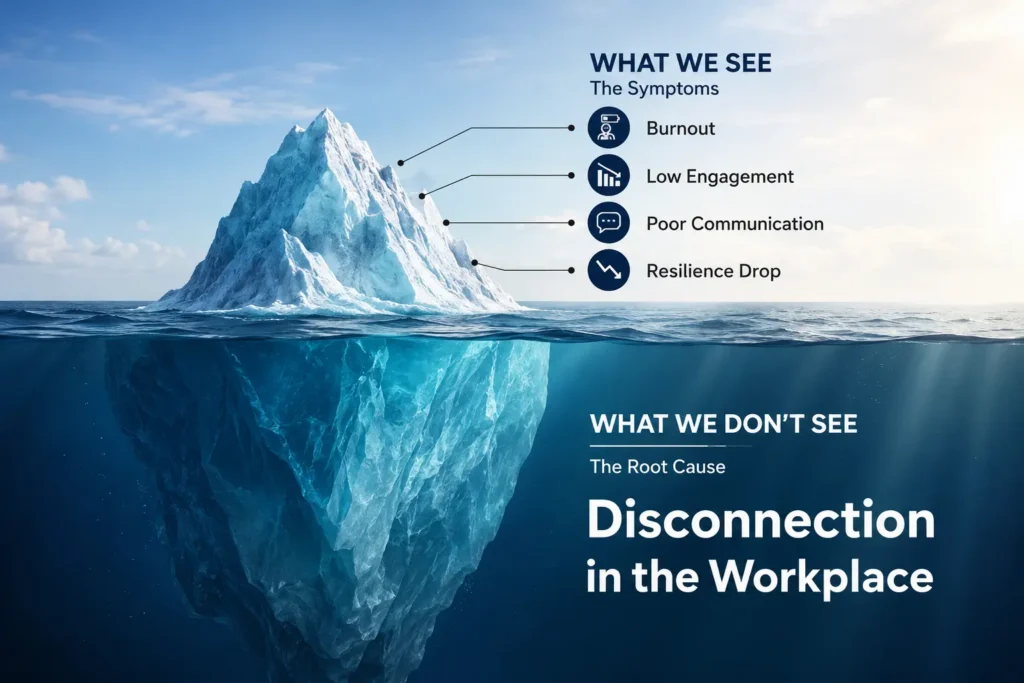
For years, organizations have invested billions of dollars trying to solve burnout, improve communication, increase engagement, strengthen resilience, and build healthier corporate cultures. While these are all highly worthwhile operational goals, a critical question remains:
What if these issues aren’t the actual problem?
What if they are merely the symptoms?
After years of speaking, coaching, and working directly with leaders across multiple industries, I’ve come to realize a fundamental truth. The greatest challenge facing today’s corporate environment isn’t burnout, poor communication, or low employee engagement.
The root cause behind all of these organizational failures is disconnection in the workplace.
The Hidden Epidemic Inside Modern Organizations
Disconnection behaves like a hidden epidemic inside companies. It rarely announces itself with a major crisis; instead, it shows up quietly, eroding foundational mechanics from the inside out:
The Individual Shift: An employee no longer feels connected to the organization’s overarching mission.
The Managerial Breakdown: A leader stops practicing active curiosity and starts making critical assumptions.
The Team Withdrawal: A team member stops contributing because they no longer believe their perspective or voice matters.
The Silo Effect: Separate departments begin protecting themselves defensively instead of collaborating transparently.
Before long, what started as isolated, individual experiences becomes the dominant organizational culture.
Culture is not what is written on the lobby wall or typed in an email signature. Culture is what walks through the hallway. It is a daily, lived experience.
Symptoms vs. Root Cause: Rebuilding Your Leadership Strategy
When an organization focuses entirely on treating individual symptoms rather than fixing the systemic root cause, long-term progress stalls. True workplace transformation requires shifting the operational paradigm.
| The Symptom Focus (Traditional Programs) | The Root Cause Focus (The Connection Strategy) |
|---|---|
|
Managing Stress: Teaching employees how to endure chronic, high-pressure environments. |
Mindset Alignment: Recognizing and dismantling the reactive thinking that creates stress. |
|
Communication Skills: Memorizing conversational scripts and techniques. |
Psychological Safety: Developing the mindset that makes authentic, meaningful conversation possible. |
|
Building Culture: Designing visual branding, posters, and corporate slogans. |
Daily Behavior: Focusing on the everyday, micro-interactions that naturally generate culture. |
|
Increasing Engagement: Tracking survey metrics and deploying temporary perks. |
Restoring Connection: Reconnecting individuals to themselves, to each other, and to their purpose. |
Why Connection is the Ultimate Business Strategy
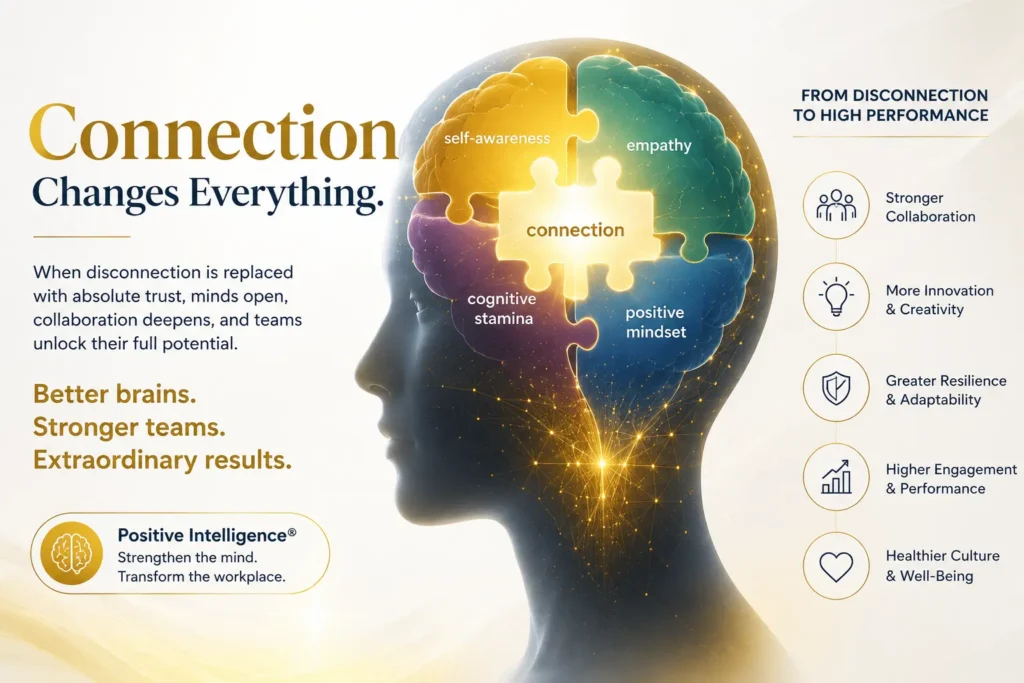
When leaders intentionally prioritize fixing disconnection in the workplace, something remarkable happens across the entire operation. Teams become naturally more resilient—not because external pressures decrease, but because their internal cognitive stamina grows.
By blending neuroscience, Positive Intelligence, and practical emotional intelligence, organizations can replace defensiveness with absolute trust.
Connected employees:
Think and innovate more clearly.
Communicate with deep curiosity rather than harsh judgment.
Collaborate fluidly across departmental lines.
Drive sustainable performance improvements.
Ultimately, joy emerges within the culture—not as an abstract goal, but as the literal fuel that energizes your workforce to perform their best work every single morning.
Summary: A New Conversation for Executive Leaders
Every business experiences moments of intense stress, market disruption, and structural change. However, the organizations that consistently thrive are the ones where people remain unshakeably connected to their peers and to a shared North Star.
Stop asking, “How do we fix burnout?” Start asking: “Where has disconnection quietly taken root, and how do we restore connection?”
Because connection isn’t a soft skill—it is a proven business strategy.
Frequently Asked Questions
What does disconnection in the workplace look like?
Why do traditional engagement and burnout programs often fail?
How does Positive Intelligence help resolve team disconnection?
Want to explore how your team or organization can build a culture of joy through mental fitness and resilient leadership? Let’s connect.

Dorice Horenstein helps organizations bring out the best in their people by creating a path to human flourishing under pressure. An international keynote speaker, Mental Fitness and Positive Intelligence® expert, and author of Choose to Be Your Own Champion and the best-selling Moments of the Heart, Dorice brings more than 30 years of leadership and education experience to her work with leaders and teams.
She equips people with the Champion Mindset and practical tools to think clearly, choose intentionally, and act confidently when it matters most.
With infectious energy, humor, and practical wisdom, Dorice transforms stress into clarity, disconnection into meaningful connection, and everyday challenges into opportunities for growth. Her unique approach connects brain and heart—combining neuroscience and mental fitness with decades of leadership experience and universal wisdom.
Dorice inspires people to rise to their Champion Level, strengthen relationships, and create workplaces where people and performance flourish together.