Building a Culture of Excellence: Why It's a Marathon, Not a Sprint
What if success wasn’t just about achievement, but about how we show up every day?
We live in a world obsessed with overnight wins, viral moments, and rapid results. But building a culture of excellence, in yourself, your team, or your organization, doesn’t work that way. Excellence is not a destination. It’s a daily practice. And the people who truly embody it aren’t the ones who had a perfect launch. They’re the ones who quietly, consistently did the work when no one was watching.
Beyond the Finish Line:
Redefining Success Through the Power of Daily Practice
True excellence isn’t an overnight win or a single achievement, but a daily commitment to showing up with intention, patience, and consistency. By focusing on small, 1% incremental improvements and mastering the habits of resilient leadership, we can carve out lasting success and inspire everyone around us to rise.
The Myth of Overnight Success
Think about your favorite athlete. Their “overnight win”? Likely 10 or more years of drills, losses, and 5am workouts. That colleague who just got promoted? Their “sudden” success was probably years of small, steady steps nobody noticed until they became impossible to ignore.
Research cites the concept of roughly 10,000 hours to develop true mastery in a skill. But here’s the more important insight: you don’t need mastery to start seeing results. You just need daily progress.
As Lao Tzu put it, “The journey of a thousand miles begins with a single step.”
Building a culture of excellence starts exactly the same way, one intentional step at a time.
What Does Building a Culture of Excellence Actually Mean?
Excellence is not a checklist. It’s not a title. It’s not even a single achievement.
It’s the how, how we treat others, how we lead ourselves, how we respond to setbacks, and how we choose to rise each morning with purpose and intention. A culture of excellence is built when individuals commit to that standard consistently, especially when it’s inconvenient.
The 3 Laws of Long-Term Excellence
| Law | Principle | What It Looks Like in Practicce |
|---|---|---|
|
The 1% Rule |
Small improvements compound over time |
1% better every day = 37x growth in a year |
|
Embrace the Journey |
Plateaus are preparation, not failure |
Trusting the process even when progress isn’t visible |
|
Fall in Love with the Work |
Commitment outlasts motivation |
Showing up even when passion temporarily fades |
Law 1: The 1% Rule
Small improvements compound. Getting 1% better every day doesn’t feel dramatic — but over the course of a year, that compounds into 37 times the growth. Building a culture of excellence isn’t about dramatic leaps. It’s about daily inches.
Law 2: Embrace the Journey
Progress is rarely linear. There will be plateaus that feel like failure — but they’re actually preparation. Growth is happening beneath the surface even when you can’t see it yet. Excellent leaders understand this and don’t abandon the process when results are slow.
Law 3: Fall in Love with the Work (Not Just the Outcome)
Passion will ebb and flow. Motivation fades. Infatuation with results is temporary. But commitment — that’s where excellence actually lives. Choosing to show up even when you don’t feel like it is the defining habit of those who build lasting excellence.
5 Champion Habits for Building a Culture of Excellence Every Day
Building a culture of excellence in yourself and your team requires daily, intentional practice. These five habits are where that culture gets built — one interaction, one decision, one moment at a time.
- 1
Be Present with Purpose
Excellence starts with full presence. When you show up completely, to a meeting, a conversation, a project, people feel your energy and attention. Bring intention to every interaction. Ask yourself: “What impact do I want to leave today?”
- 2
Lead Yourself First
Before you can inspire others, you must manage your own mindset. This means developing genuine mental fitness: silencing the inner voice of doubt and activating your inner wisdom. A culture of excellence is always built from the inside out.
- The Connection Loop: Understanding creates connection, and connection creates trust.
- 3
Respond, Don’t React
Life throws curveballs. Excellence lives in the pause, that moment when you choose a thoughtful response over a knee-jerk reaction. Resilient leaders who build excellent teams are those who master this space between stimulus and response.
- 4
Elevate Others
True excellence is never selfish. A kind word, a moment of real listening, a small gesture of recognition, these actions ripple far beyond what you can see in the moment. Look for opportunities to lift others.
A team can easily survive external pressure when deep internal trust exists. Without it, even small stressors create immediate division.
- 5
Show Up Consistently
Excellence is a habit. It’s built in the daily decisions to show up, speak up, and stand tall — even when it’s hard. Especially when it’s hard.
A Story Worth Remembering: Rabbi Akiva and the Stone
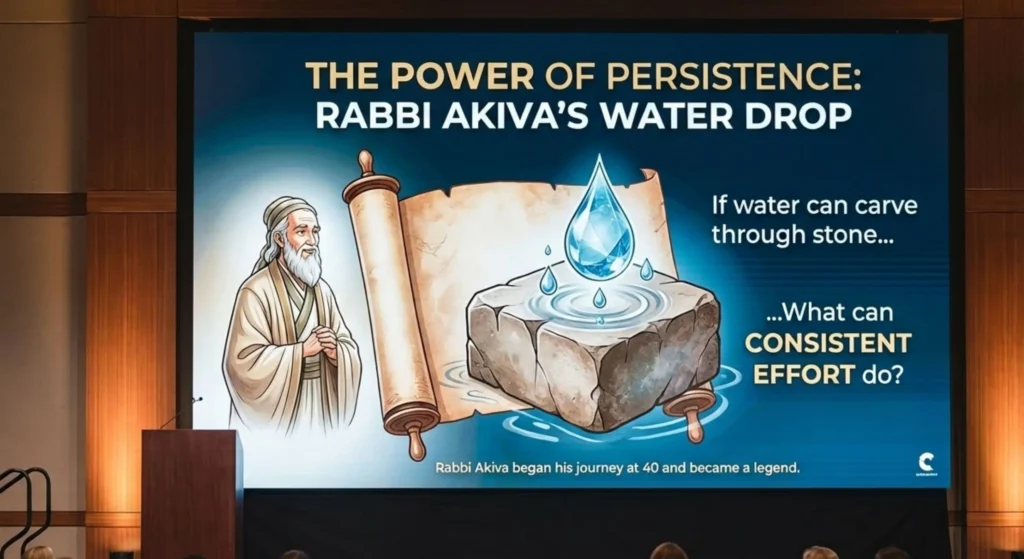
Rabbi Akiva, one of the most revered Jewish sages, didn’t begin his life’s studies until he was 40 years old. What sparked his transformation? He observed a stone that had been gradually worn down, not by force, but by the steady, persistent dripping of water over time. In that moment, he understood: if water could carve through stone, surely consistent effort could shape a human soul.
He began his journey. And became extraordinary.
This mirrors what great teachers of leadership, including Simon Sinek, have long understood: consistency in values-driven action builds trust and leadership over time, not overnight. Building a culture of excellence, like that stone, is shaped by patience, persistence, and purpose.
The 30-Day Excellence Challenge
Try this: For the next 30 days, track one skill or habit for just 15 minutes daily. Not “until you’re perfect” — just consistent. Watch what compounds.
The goal isn’t perfection. The goal is evidence — proof that you showed up and did the work. That evidence, accumulated over time, becomes the foundation of genuine excellence.
Redefining What “Winning” Means
Instead of asking “Did I succeed today?” — try asking:
“Did I show up with intention and heart?”
Because success may open the door. But it’s excellence that keeps it open.
And when you practice and build a culture of excellence — you don’t just win. You inspire others to rise with you.
Frequently Asked Questions About Building a Culture of Excellence
What is the difference between success and excellence?
How long does it take to build a culture of excellence?
Can excellence be taught or is it innate?
What are the biggest barriers to building a culture of excellence?
How do leaders build a culture of excellence in their teams?
What is the 1% Rule and how does it apply to excellence?
Want to explore how your team or organization can build a culture of excellence through mental fitness and resilient leadership? Let’s connect.

Dorice Horenstein helps organizations bring out the best in their people by creating a path to human flourishing under pressure. An international keynote speaker, Mental Fitness and Positive Intelligence® expert, and author of Choose to Be Your Own Champion and the best-selling Moments of the Heart, Dorice brings more than 30 years of leadership and education experience to her work with leaders and teams.
She equips people with the Champion Mindset and practical tools to think clearly, choose intentionally, and act confidently when it matters most.
With infectious energy, humor, and practical wisdom, Dorice transforms stress into clarity, disconnection into meaningful connection, and everyday challenges into opportunities for growth. Her unique approach connects brain and heart—combining neuroscience and mental fitness with decades of leadership experience and universal wisdom.
Dorice inspires people to rise to their Champion Level, strengthen relationships, and create workplaces where people and performance flourish together.