Building a Healthy Workplace Culture: It Is Not a Poster on the Wall
Building a healthy workplace culture is often misunderstood. When people talk about organization dynamics, they frequently point to the mission statement framed in the lobby, their email signatures, the values written on the website, or the inspirational slogans printed on coffee mugs.
But building a healthy workplace culture is not about what hangs on the wall.
highlight
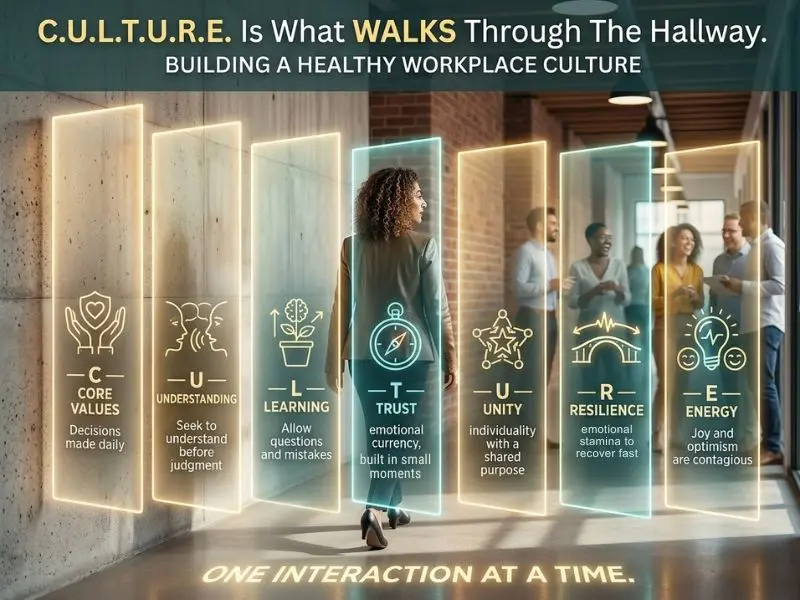
Culture is what walks through the hallway.
It is how people speak to one another when pressure rises. It is how leaders respond when mistakes happen. It is whether people feel psychologically safe to contribute, disagree, innovate, and grow. True culture is not built by branding alone—it is built entirely by behavior.
The Spoken Language of the Hallway
I recently shared with a leadership team that you can walk into a company and immediately feel its environment before anyone explains it to you. You see it in body language. You hear it in tone. You notice whether people are guarded or connected. You see what they wear and how they handle themselves and others.
Imagine entering a workplace where everyone shows up in workout gear, sneakers, and Peloton energy, and one person walks in wearing a stiff three-piece suit. Neither is wrong. But one clearly understands the rhythm of the environment, and the other does not. Culture has an unspoken language.
The deeper question for executives focused on building a healthy workplace culture is this: What are we silently teaching people about “how we do things here”?
Because culture is always teaching – sometimes intentionally, sometimes accidentally. The strongest teams are not the ones that try to please everyone. They are the ones courageous enough to define what they stand for. Sometimes culture means saying: “This behavior does not align with who we are.” Boundaries are not the enemy of accountability; boundaries protect your people.
The Traditional vs. Mentally Fit Culture
Mental fitness plays a major role in this conversation because emotionally reactive environments weaken trust, communication, and innovation. A mentally fit culture helps people respond rather than react. It creates space for curiosity instead of judgment and accountability instead of blame.
| Focus | The Traditional Workplace Approach | The ChampMentally Fit Workplace Cultureion Leadership Shift |
|---|---|---|
|
Daily Stressors |
High emotional reactivity, panic, and pointing fingers. |
Pausing to respond with clarity rather than reacting out of frustration. |
|
Friction & Mistakes |
Immediate judgment, blame, and defensive posturing. |
Space for genuine curiosity, active accountability, and deep learning. |
|
Team Communication |
Guarded, siloed conversations driven by a fear of failure. |
High psychological safety to contribute, disagree, and innovate safely. |
The C.U.L.T.U.R.E. Framework for Leaders
To move beyond empty slogans and focus on actively building a healthy workplace culture, leaders can evaluate their daily interactions through this structured framework:
- 1
C — Core Values
Healthy organizations are rooted in shared values, not empty slogans. Values become culture only when they are practiced consistently. Respect, integrity, collaboration, and accountability are not just words for a website; they are decisions made daily.
- The Leadership Rule: People watch what leaders tolerate far more than what leaders preach.
- 2
U — Understanding
Healthy environments seek to understand before rushing to judgment. Different generations, personalities, communication styles, and backgrounds will naturally create friction. But mentally fit teams learn to become curious instead of critical.
- The Connection Loop: Understanding creates connection, and connection creates trust.
- 3
L — Learning
Strong teams do not punish growth. They allow people to ask questions, make mistakes, improve, and evolve. A growth mindset says, “We are not finished becoming.” Learning spaces create resilient employees because people stop fearing failure and start viewing challenges as opportunities to strengthen.
- 4
T — Trust
This is a big one! Trust is the emotional currency of your organization. Without trust, communication becomes guarded, creativity shrinks, and collaboration weakens. Trust is built in small moments:
Keeping your word consistently.
Listening fully without interrupting.
Addressing conflict directly and privately.
Giving people dignity during difficult corrections.
A team can easily survive external pressure when deep internal trust exists. Without it, even small stressors create immediate division.
- 5
R — Resilience
Every organization will eventually face challenge, disappointment, change, or uncertainty. The question is never whether difficulty will come; the question is how your people will respond when it does. Resilient teams recover faster because they have emotional stamina. They communicate, adapt, and stay connected during pressure rather than turning against one another. They share the exact same North Star!
- 6
E — Energy
Every single person contributes energy into a workplace. Some bring encouragement, some bring tension, and some bring possibility. Energy is highly contagious. That is why joy, optimism, gratitude, and emotional regulation are never “soft skills” – they directly influence morale, productivity, retention, and engagement.
A culture filled with chronic negativity eventually drains performance.
A culture filled with grounded positivity expands possibility.
A team can easily survive external pressure when deep internal trust exists. Without it, even small stressors create immediate division.
Summary: One Interaction at a Time
At the end of the day, building a healthy workplace culture is deeply human. It is not built in one retreat. It is not fixed through one email broadcast. It is not sustained through beautiful branding alone.
Culture is created one interaction at a time:
One intentional conversation.
One measured response under pressure.
One small act of mutual respect.
One courageous boundary held.
One critical moment of choosing curiosity over judgment.
Perhaps the greatest question every executive should ask is: “What does it feel like to work around me?” Because culture is not something “out there” – it starts exactly where you stand.
Frequently Asked Questions
How does leadership behavior directly impact workplace culture?
Why are clear boundaries essential for a healthy team culture?
What is the difference between organizational unity and conformity?

Dorice Horenstein helps organizations bring out the best in their people by creating a path to human flourishing under pressure. An international keynote speaker, Mental Fitness and Positive Intelligence® expert, and author of Choose to Be Your Own Champion and the best-selling Moments of the Heart, Dorice brings more than 30 years of leadership and education experience to her work with leaders and teams.
She equips people with the Champion Mindset and practical tools to think clearly, choose intentionally, and act confidently when it matters most.
With infectious energy, humor, and practical wisdom, Dorice transforms stress into clarity, disconnection into meaningful connection, and everyday challenges into opportunities for growth. Her unique approach connects brain and heart—combining neuroscience and mental fitness with decades of leadership experience and universal wisdom.
Dorice inspires people to rise to their Champion Level, strengthen relationships, and create workplaces where people and performance flourish together.