WORKPLACE WELLBEING
Workplace Disconnection:
The Hidden Cost of the Conversation We Avoid

A Familiar Experience
Have you ever been hurt by something someone said – or didn’t say – and decided it was easier just to step away?
I have. More than once.
Someone says something that stings. A colleague disappoints us. A friend makes a comment that lands differently than they intended. A leader makes a decision that leaves us feeling unseen.
We tell ourselves:
- “It’s not worth bringing up.”
- “I don’t want to make this into a big deal.”
- “I’ll just move on.”
Except…we don’t really move on. We move away. And that is where disconnection begins.
The Hidden Cost
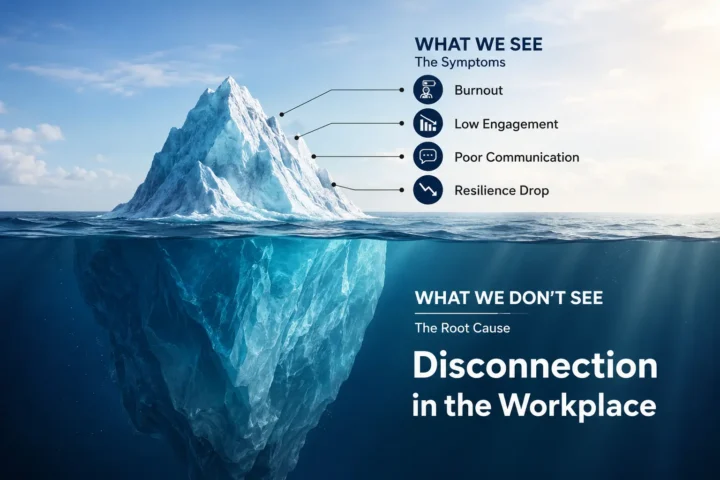
When we hear the word “disconnection,” we often imagine a dysfunctional team where people barely speak to one another.
But disconnection can be much quieter than that.
Two colleagues still attend the same meetings. They still exchange emails. They still smile and say, “Good morning.”
But something has changed.
One person was hurt. The conversation never happened. Now they share a little less. They ask fewer questions. They stop seeking the other person’s opinion. They avoid being vulnerable.
A small invisible barrier begins to grow. And organizations pay a price for barriers nobody can see.
Because what starts as an unspoken feeling can eventually become a communication problem, a trust problem, a collaboration problem – and ultimately a performance problem.

What starts as an unspoken feeling can eventually become a communication problem, a trust problem, a collaboration problem, and ultimately a performance problem

I Have Done This Too
I wish I could tell you that because I teach resilience, mental fitness, and connection, I always lean into difficult conversations.
I don’t.
I have faced this situation many times in my own life.
There have been moments when someone hurt me and instead of leaning into the relationship, I stepped away.
It felt safer…Perhaps you’ve done that too.
The problem is that stepping away may protect us from an uncomfortable conversation today while creating a larger barrier tomorrow.
I’ve learned that resilience isn’t pretending something didn’t hurt. And connection isn’t ignoring our feelings for the sake of keeping the peace. We need a different approach.
Feelings Are Data Indicators, Not Dictators
This sentence became one of my favorites and is something I teach: Feelings are data indicators, not dictators.
There is an important difference.
When I feel hurt, frustrated, disappointed, or excluded, my feeling contains information—honor it.
Ask::
- What am I feeling?
- Why did this affect me?
- What might I need right now?
- What story am I telling myself about what happened?
But then comes the critical part: Don’t automatically let that feeling decide what you do next.
Your feeling deserves a seat at the table. It doesn’t get to run the meeting. That distinction is mental fitness in action.
Feelings vs. Choices
| Feelings | Might Say |
|---|---|
| Hurt | Avoid her. |
| Anger | Show him you’re upset. |
| Fear | Don’t bring it up. |
| Sadness | Withdraw. |
| Frustration | Assume the worst. |
Honor what you're feeling. Then choose an action that serves the relationship, not just your immediate emotional reaction.
A Choice at the Fork in the Road
Think about what happens after we’re hurt. We arrive at a tiny fork in the road.
One path is avoidance — we don’t say anything. We withdraw. We make assumptions. We replay the conversation in our heads. Eventually, we begin collecting evidence that confirms what we already believe about the other person.
Brick by brick, we build a wall. A wall between us and “them.”
The other path is curiosity and courageous communication. We honor what we’re feeling and then choose an action that serves the relationship rather than simply obeying our immediate emotional reaction.
That might sound like:
“Something from our conversation stayed with me, and I’d rather talk about it than make assumptions.”
That one sentence can change everything. Not every difficult conversation ends exactly as we hope. But avoiding the conversation almost guarantees that the other person never has the opportunity to understand what happened.

Feelings Are Data Indicators, Not Dictators
This sentence became one of my favorites and is something I teach: Feelings are data indicators, not dictators.
There is an important difference.
When I feel hurt, frustrated, disappointed, or excluded, my feeling contains information—honor it.
Ask::
- What am I feeling?
- Why did this affect me?
- What might I need right now?
- What story am I telling myself about what happened?
But then comes the critical part: Don’t automatically let that feeling decide what you do next.
Your feeling deserves a seat at the table. It doesn’t get to run the meeting. That distinction is mental fitness in action.
Three Steps to Take
- Name It. What am I actually feeling?
- Examine It. What is the feeling telling me, and what assumptions am I adding?
- Choose It. What action will move me toward the relationship, leader, or person I want to be?
Reflection
What one conversation have you been avoiding? What are you feeling? And what is one small step you can take toward more connection today?
Key Takeaway
The goal isn't to eliminate emotion. It's to honor the feeling without surrendering our choices to it.
Frequently Asked Questions
| What is workplace disconnection? | Workplace disconnection occurs when people begin withdrawing emotionally or relationally from colleagues, leaders, their team, or their work. It can show up as avoidance, reduced communication, unresolved tension, lack of trust, or simply no longer sharing what we really think and feel. |
| What causes disconnection between coworkers? | Disconnection can begin with something surprisingly small: a hurtful comment, feeling excluded, a misunderstanding, an unresolved disagreement, or an assumption that is never discussed. When people avoid addressing what happened, emotional distance can grow. |
| How can leaders reduce disconnection at work? | Create an environment where people can respectfully address tension rather than avoid it. Help employees name what they are feeling, examine the assumptions behind those feelings, and intentionally choose actions that support communication and connection. |
| Should we ignore emotions in order to be professional? | No. Emotions provide useful information. The goal isn’t to suppress them or automatically act on them. As Dorice teaches, “Feelings are data indicators, not dictators.” We can honor what we feel while intentionally choosing how we respond. |
| How does mental fitness help workplace relationships? | Mental fitness helps us notice our automatic reactions before they determine our behavior. That space between feeling and action gives us an opportunity to replace avoidance or reactivity with curiosity, communication, and intentional choice. |
| What is the connection between workplace disconnection and performance? | When people withdraw from one another, they may share fewer ideas, ask fewer questions, collaborate less openly, and avoid difficult conversations. What appears to be a performance or communication problem may actually have started as a relationship problem. |
| Who speaks about workplace disconnection, mental fitness, and resilience? | Dorice Horenstein is an international resilience and mental fitness keynote speaker, author, and Oy to Joy Champion Catalyst. Her work helps leaders and organizations recognize disconnection, strengthen mental fitness, create meaningful connection, and bring out the best in their people. |
Want to Build a More Connected, Mentally Fit Workplace?
Dorice partners with organizations, leaders, and teams to strengthen resilience, communication, and connection. Through engaging keynotes, workshops, and leadership experiences, she helps people move from disconnection and stress toward clarity, confidence, and joy.

Dorice Horenstein helps organizations bring out the best in their people by creating a path to human flourishing under pressure. An international keynote speaker, Mental Fitness and Positive Intelligence® expert, and author of Choose to Be Your Own Champion and the best-selling Moments of the Heart, Dorice brings more than 30 years of leadership and education experience to her work with leaders and teams.
She equips people with the Champion Mindset and practical tools to think clearly, choose intentionally, and act confidently when it matters most.
With infectious energy, humor, and practical wisdom, Dorice transforms stress into clarity, disconnection into meaningful connection, and everyday challenges into opportunities for growth. Her unique approach connects brain and heart—combining neuroscience and mental fitness with decades of leadership experience and universal wisdom.
Dorice inspires people to rise to their Champion Level, strengthen relationships, and create workplaces where people and performance flourish together.